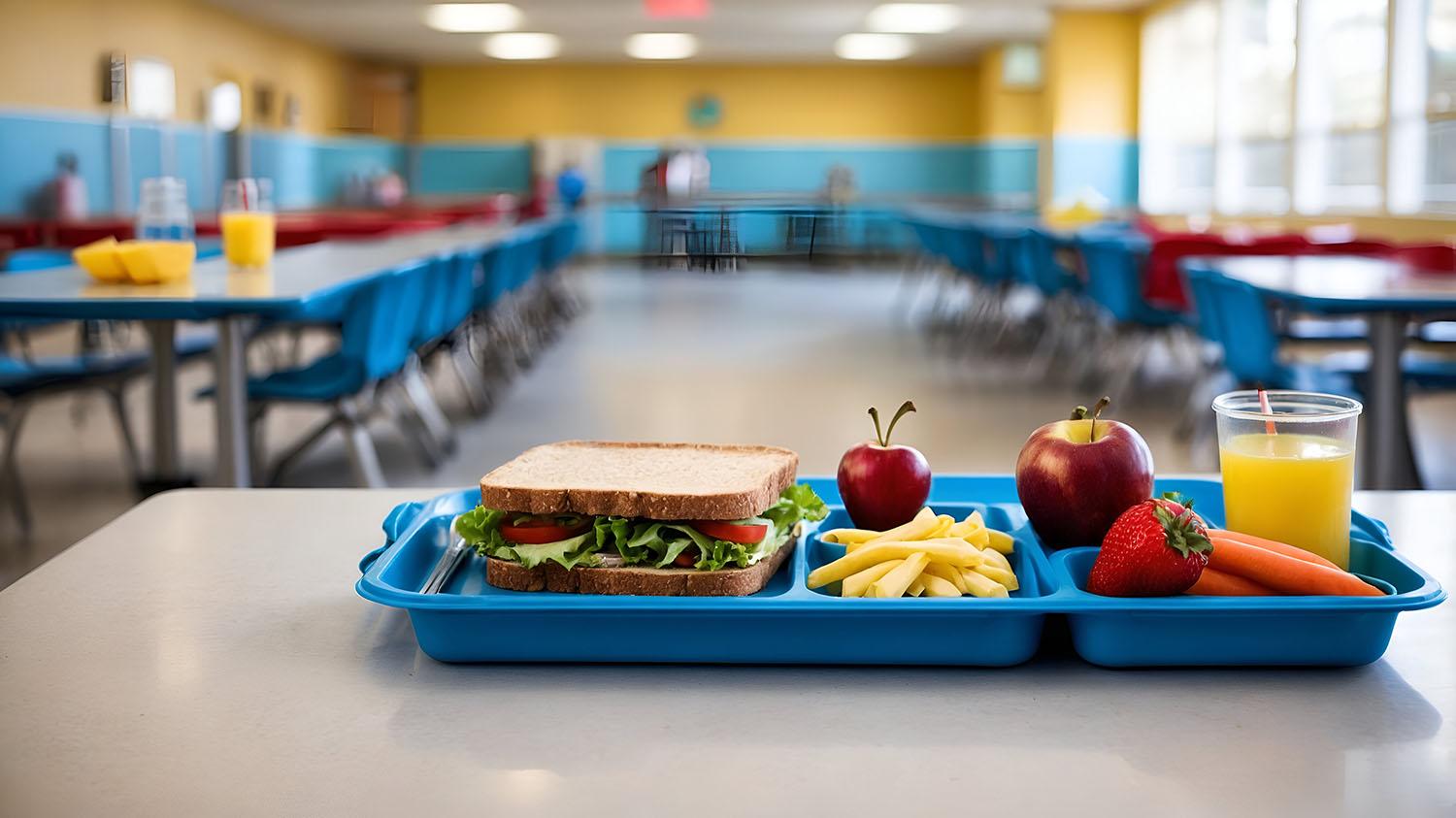
The Government approves a royal decree to ensure that all children have five healthy meals a week in schools


The regulation, drafted by Social Rights and Consumer Affairs, also eliminates industrial pastries and energy drinks, limits processed and fried foods, and promotes sustainable and seasonal products, as well as local agricultural and livestock production.
With this royal decree, the right to a nutritious and varied diet for all children will be guaranteed, regardless of their families’ income level, and based on health recommendations from scientific bodies such as AESAN or the WHO.
In addition, the Council of Ministers approved this Tuesday a budget of 200 million euros, which the ministry led by Bustinduy will distribute to the autonomous communities to fund family protection and child poverty support programs.
Madrid, April 15, 2025.– The Council of Ministers approved this Tuesday the Royal Decree on Healthy and Sustainable School Canteens, a text presented by Pablo Bustinduy and drafted by the ministry he leads (Social Rights, Consumer Affairs and Agenda 2030), together with four co-proposing ministries (Education, Vocational Training and Sports; Agriculture, Fisheries and Food; Health; and Youth and Children). As Bustinduy highlighted at the press conference held at the Moncloa Palace after the Council meeting, this new regulation will guarantee that five healthy meals are served per week in all schools. This includes public, state-subsidized, and private schools that provide early childhood education (second cycle), primary education, special education, compulsory secondary education, baccalaureate, or basic or intermediate vocational training programs.
In this way, the minister explained, the royal decree will ensure that all children and adolescents in our country have daily access to a healthy, nutritious, and varied diet in school canteens, regardless of their families’ income level. This last point is important, Bustinduy stressed, since the school canteen is a key tool for reducing inequality and guaranteeing every child’s right to quality food, as well as helping them acquire healthy eating habits for the rest of their lives.
On this issue, the minister recalled one of the findings of the latest Aladino study: half of the students (46.7% of those aged 6 to 9) from families with annual incomes below 18,000 euros are overweight, due to the fact that, as the study indicated, they cannot afford to consume more fresh foods such as fruits and vegetables or have complete breakfasts. This decree therefore aims to ensure that students have equal access to healthy food in school canteens.
Daily fruit and vegetables, local production, and more fish and legumes
The royal decree states that all schools with canteens must guarantee students daily consumption of fresh fruit and vegetables, specifying that at least 45% of the fruit and vegetables served must be seasonal, in order to promote healthier and more sustainable canteen models while also strengthening local production. This is a noteworthy measure, said the minister, as it will benefit Spanish farmers and livestock producers in a difficult context such as the current one due to the international tariff war initiated by the United States.
The minister also explained that the benefits of this proposal have already been demonstrated in various successful initiatives underway in different parts of the country, such as the Ecocomedores project in the Canary Islands and the Horta Cuina project in the Valencian Community. Bustinduy has personally visited some of the school canteens involved in these initiatives in recent months. In this regard, he also emphasized that the regulation establishes that at least two dishes per month or 5% of spending must be allocated to organic production.
Likewise, Bustinduy highlighted that the royal decree ensures increased consumption of fish, legumes, and whole grains in school canteens. To this end, the regulation sets weekly portions based on recommendations from scientific and health bodies such as AESAN (Spanish Agency for Food Safety and Nutrition) and the WHO (World Health Organization). On this basis, the regulation establishes serving between one and three portions of fish per week, which will significantly increase fish consumption nationwide, as according to estimates by the Ministry of Consumer Affairs, there are 1,200 school canteens in Spain where fish is never served (based on data from the National Official Food Chain Control Plan 2021–2025 report).
Similarly, the consumption of legumes is promoted due to their high nutritional value and health benefits, encouraging their presence in menus either as a first or second course or as a side dish. Currently, according to data provided by the autonomous communities themselves, up to 14% of schools failed to meet the recommendation of serving legumes at least once a week. Regarding cereals, the royal decree stipulates that at least one serving of whole-grain rice or pasta should be offered weekly, along with several servings of whole-grain bread.
Elimination of sugary drinks, energy drinks, and industrial pastries
Another key point of the royal decree, Bustinduy noted, is that sugary drinks will not be allowed in school meals, nor sold in vending machines or cafeterias within these centers. In this line, energy drinks and sugary foods (so-called industrial pastries) sold in these vending machines and cafeterias will also be eliminated. Specifically, products exceeding a maximum of 5 grams of sugar per packaged portion and failing to meet recommended criteria from organizations such as the WHO regarding limits on fat, sugar, and salt intake will not be permitted:
- The energy value per packaged portion must not exceed 200 kilocalories. This relates to the recommendation to distribute daily energy intake as follows: 25% at breakfast (or 15% if it is a light breakfast complemented by a 10% mid-morning snack), 35% at lunch, 10% at afternoon snack, and the remaining 30% at dinner. Therefore, considering that students aged 4 to 16 require around 2,000 kilocalories per day, mid-morning and afternoon snacks should not provide more than 10% of total daily energy intake—that is, a maximum of 200 kilocalories.
- Calories from fat must not exceed 35%, meaning a maximum of 7.8 grams of fat per portion of 200 kilocalories.
- For saturated fats, calories from this source must not exceed 10%, meaning a maximum of 2.2 grams per portion.
- For added or free sugars, the same percentage applies: a maximum of 10% of total kilocalories, equivalent to 5 grams per 200-kilocalorie portion.
- As for salt, the maximum should be 0.5 grams (0.2 grams of sodium) per 200-kilocalorie portion.
Currently, as detailed in the National Official Food Chain Control Plan report, nearly 70% of vending machines in schools fail to meet recommended nutritional criteria, while non-compliance among school cafeterias is even higher, affecting 74% of them.
Limit on processed dishes and fried foods
Minister Bustinduy also emphasized that the royal decree will limit processed dishes to just one serving per month. This means that foods such as pizzas, empanadillas, or pre-prepared fried items may only be served once a month at most. Meanwhile, freshly prepared fried foods (not from processed products) may be served once a week at most, with a preference for using olive oil or high-oleic sunflower oil.
National Strategic Plan for the Reduction of Childhood Obesity 2022–2030
The regulation approved today is titled “Royal Decree establishing implementing rules for Law 17/2011 of July 5 on food safety, to promote healthy and sustainable eating in educational centers,” and develops the 2011 Food Safety and Nutrition Law, specifically Article 40, which explicitly refers to special measures in the school environment. This decree also advances the implementation of the National Strategic Plan for the Reduction of Childhood Obesity 2022–2030, presented by Pedro Sánchez, Prime Minister of Spain, together with Pau Gasol, founder of the Gasol Foundation; María Neira, Director of Public Health at the WHO; and Ernesto Gasco, High Commissioner for the Fight Against Child Poverty. The plan calls for “developing national regulations that establish criteria to ensure that the food offered in school, health, and sports settings for children (school canteens, children’s menus, vending machines, and cafeterias) is healthy, nutritionally adequate, and sustainable.”
200 million euros to support families and tackle child poverty
In addition, this Tuesday the Council of Ministers approved another proposal by Pablo Bustinduy: the distribution of 200 million euros (€198.7 million) among the autonomous communities to strengthen family protection policies, tackle child poverty, and reinforce social services. Within this budget, and in line with the objectives of the Royal Decree on Healthy and Sustainable School Canteens, €65 million will be allocated to social intervention projects and benefits for families at risk of poverty. This funding will support initiatives aimed at improving the situation of vulnerable households by covering basic needs such as food, hygiene, and clothing, as well as funding school meal grants, school supplies, and rental assistance.